Posts

Mise en scène

Image
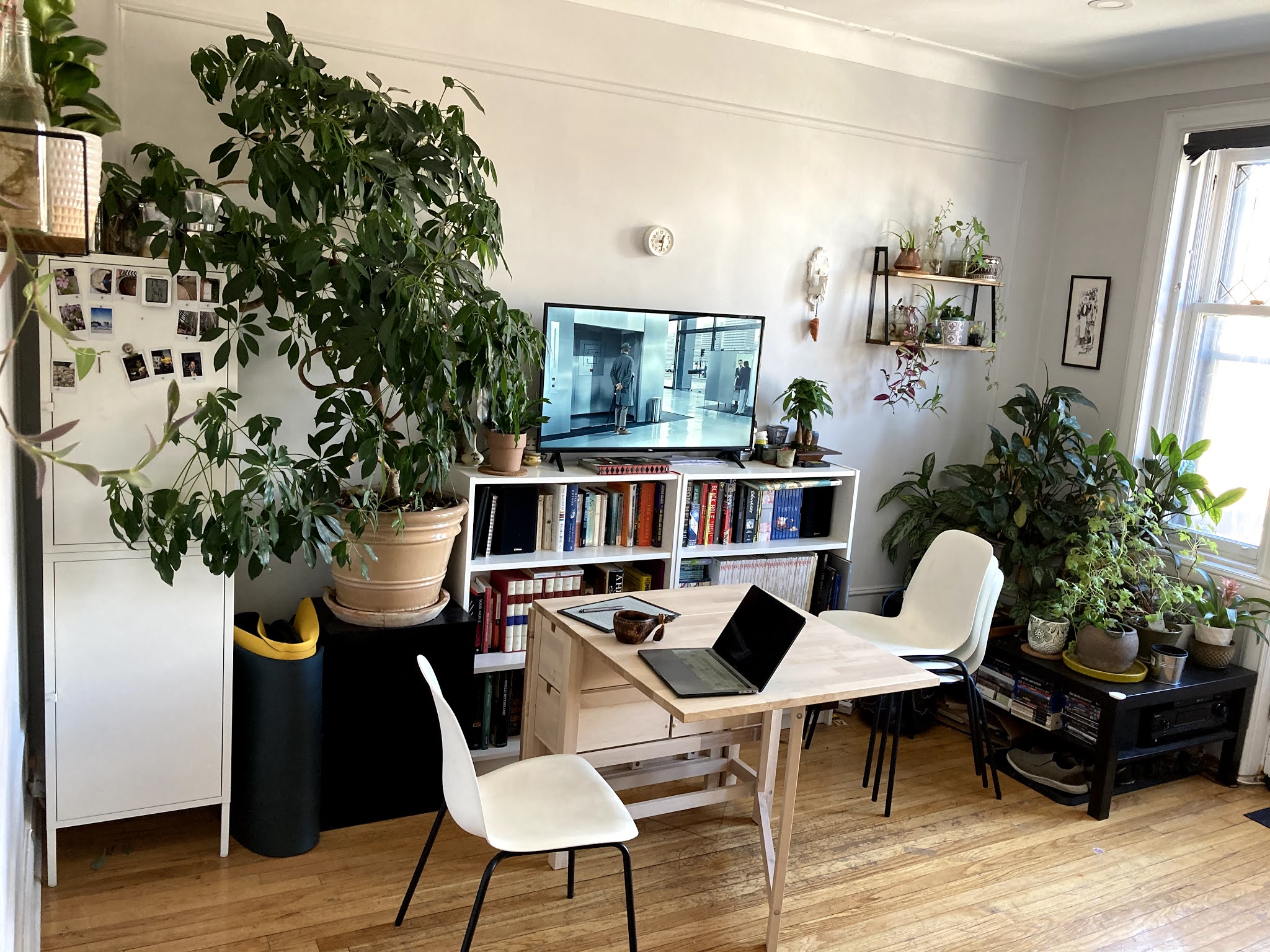
Aditi lent me her workspace today, it's making me happy. The pandemic encouraged her to transform our living room into something very flexible and modular. It's so her, so lush with greenery, part yoga studio, part editorial office, part nonprofit organizing and fundraising space, and ultimately a living space. In this age of mise-en-screen in virtual background, it offers a lot of possibilities. Not pictured is Aditi's "doors" photography series, featuring New Orleans (French quarter) and Montreal (plateau), and our fiction/craft bookshelves.  I've also been playing with the use of cinema to transform TVs from eyesores to art. Jacques Tati's work is particularly suited for it. The mise-en-scène is immaculate. Every frame a perfect tableau. Astonishing sound design: Not music, but musical. Non-narrative: you can absorb the movies over many partial viewings. On a good television, with good audio, the unfolding of a Tati movie is like great painting. It can ...

Coherence in Machine-Assisted Qualitative Research

Image
This is the first  in a  series of posts  exploring  the notion of coherence when using topic  modeling  methods like Latent Dirichlet Allocation (LDA) for qualitative analysis of texts. I'm trying to think about how mechanically measured coherence matters when you are trying to interpret something qualitatively from a large corpus of texts (with the assistance of machine-learning tools). Having estimated many, many LDA models of  similar  corpora of texts over the last few months for one reason or the other , I have started to observe some methodologically salient patterns in coherence . So  this post will amount to me trying to reflect on the tacit knowledge gained from "doing" topic modeling repeatedly. I hope there is value in this for others attempting to use methods like LDA to support qualitative analysis of texts. To illustrate my reflections, I will refer to a "vignette," comprised of R code, results, and visualizations of LDA ana...

Is a gun a gun when no one pulls its trigger? Reflections on the Endnote from Orlikowski 2000, Org Science.

Image
 This is the paper to which I am referring in this post. Orlikowski, W. J. (2000). Using technology and constituting structures: A practice lens for studying technology in organizations.  Organization science ,  11 (4), 404-428. In the endnote of this paper, Orlikowski recounts an interaction with one of the anonymous referees for the paper where the question from the title of this post is posed. Orlikowski asserts that recognition of an object as a gun is culturally specific, members of a society in which nobody has ever used a gun would have no basis for recognizing an object as a gun. She poses a remote tribe in the Kalahari as an example. Knowledge of an object, she contends, comes primarily from its use.  This got me thinking about objects about which society primarily possesses knowledge derived not from use, rather from designs, specifications, manuals, and other texts.  Orlikowski refers to technological artifacts, and I'll take that as a cue to focus o...

Abhivadaye: Lineage in knowledge produced by communities of experts

Image
This is how I count things.  Its weird, I know. I count in base 12. I never gave it much thought before. I was wondering about it this past weekend so I asked my Dad about it during our weekend call. He said it was how Tamil Brahmins are taught to count off their chants. I must have retained it from when I was taught the Sandhyavandanam as a kid. There is a vedic tradition in some communities in south India- that of the elaborate self-introduction. This is called the  abhivadaye  (uh-bhee-VAA-da-yay). In it, in addition to your name, parent's name, and class signifiers, you also declare your scholarly clan, and chosen significant texts. I was taught how to introduce myself like this. In the abhivadaye I see the evidence of interactions between social and semantic structures, and how they produce each other. If there's a single antecedent to my interests in this line of inquiry, it is my meditations on the practice of abhivadaye.    Better scholars than me have...

The Doggo Coat

Image
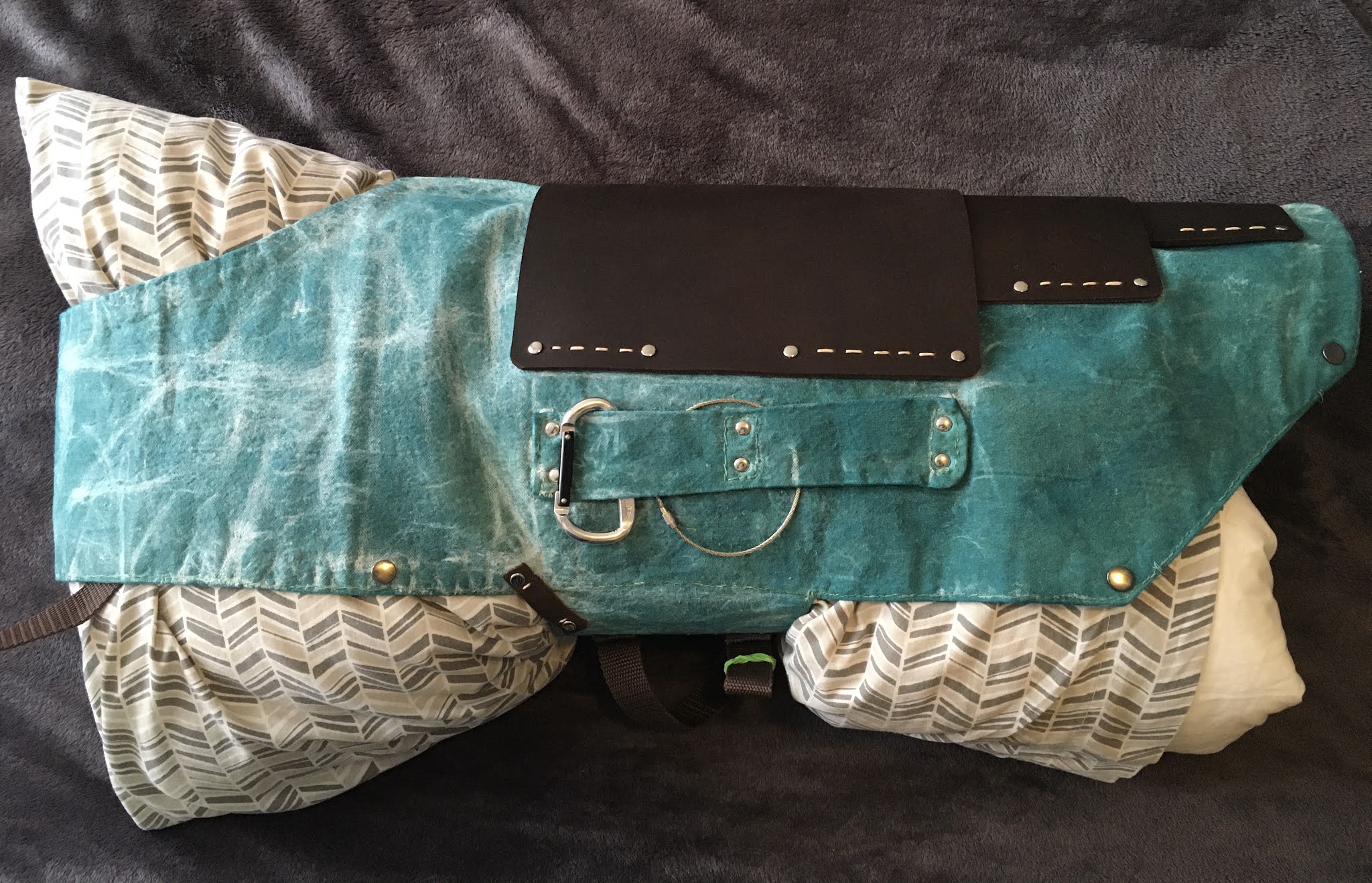
This is my second year in Montréal. What I learned from my last winter here was that woodwork or  whittling were not viable options for me. Winters are largely indoors here. The dust and the chips- that doesn't work for me in my living space. So I think its going to be fabrics and leathers for the next little while. This has increasingly dawned on me as Aditi and I worked on The Doggo Coat. This is a coat for Jasper, my sister in law Pragna's  blue heeler . He lives in Calgary and likes the outdoors. So we want something that is warm, waterproof, and doesnt get in the way of his running around. I used a pattern from Wholefully  as a reference, and to help me get measurements from Pragna over in Calgary.  I decided to go with a waxed canvas and leather outer coat and a detachable inner flannel layer, with webbing  and metal quick release buckles.  I started with 10 oz duck canvas. Washed so it gets a chance to shrink. Cut it to rough shape. I doubled up the ...

Rediscovering writing

Its no coincidence that I started this blog around the same time as I started fieldwork this fall.  There's a profound meditative quality to developing a thought through iterations of text. I'm referring to memo writing, an important aspect of qualitative research methods. I am quite good at maintaining discipline among my numbers. All my quantitative data, be it from a research project or personal logs, are well organized. My folder structure is orderly, my paths consistent, my code annotated and clean. Read JP Ferguson's post on this for inspiration if you want to do this as well. However, the idea of discipline among my words is new to me. Which is why I so glad Samer insists on disciplined memoing to accompany fieldwork. For each observation session, I take field notes, always by hand (delike alpha with a fude nib with iroshizuku shin ryoku ink on 80gsm paper notebooks). I then type out my field notes into a word doc in a secure cloud drive to which Samer has access. T...

My Coffee Ritual

Image
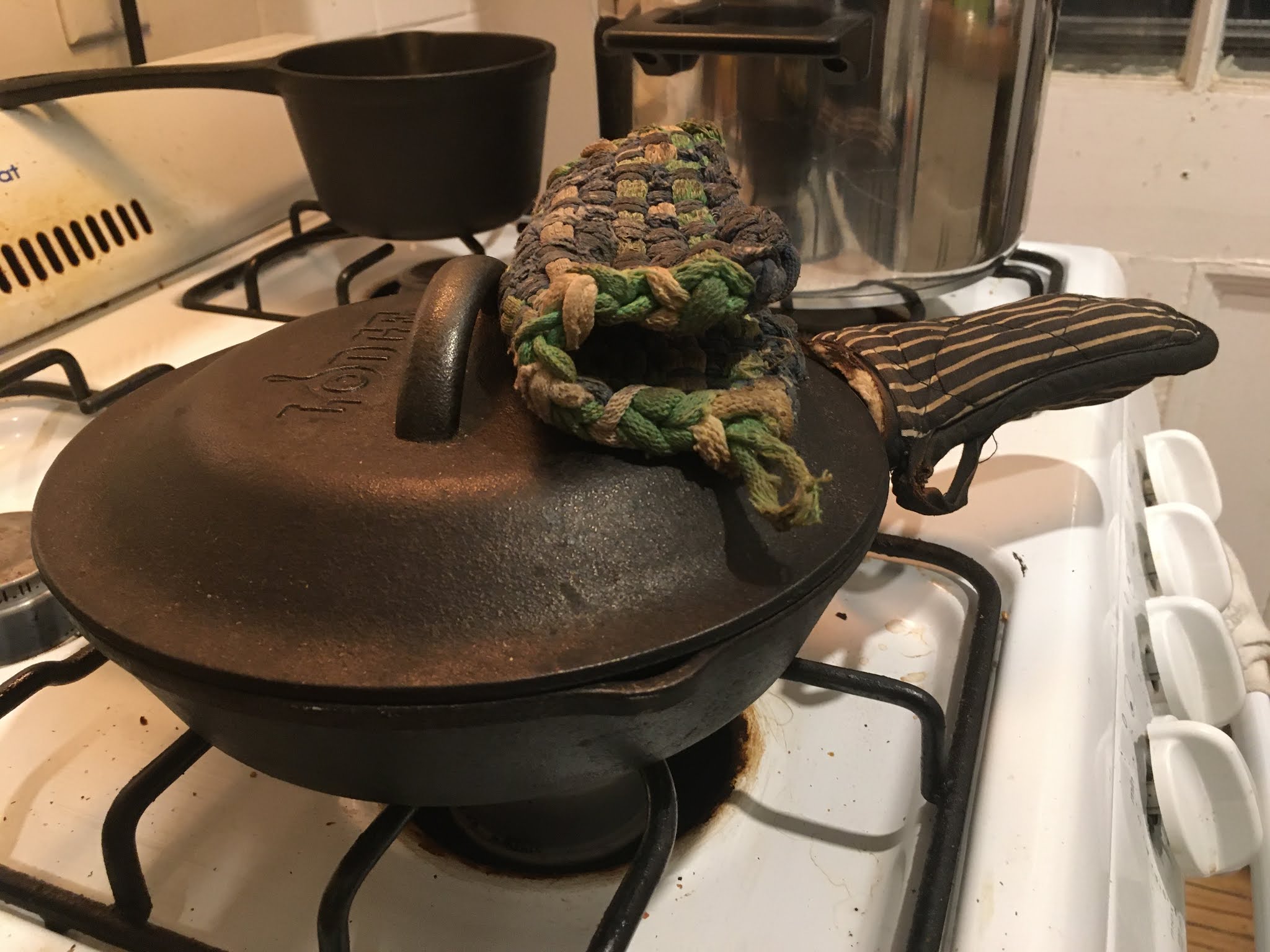
Coffee is an important part of my life, and my daily coffee ritual changes every few months. My current method for preparing coffee is espresso. The Bean This week, I'm doing a 50/50 blend. I'm working with a Tanzanian peaberry and my usual base bean, the South Indian Malabar " monsooned " or age cured bean. Both are arabica. I bought both beans, unroasted, from Green Beanery . I have hand roasted both beans, each separately in my coffee cast irons to around  City+  this past weekend, so its now 3 days post roast. With African beans, perhaps because of the coffee processing practices in the region, I find that small bits of skin remain on the bean during the roast, which then fall off when I roll the beans in the skillet. With Indian beans, I have found that the whole skin slides off from the bean as a single "husk". This peaberry is quite dense and takes longer to roast than the lighter yet bigger monsooned bean, however the former rolls quite well in the s...

Smart Scheduling and AI scheduling assistants: An extension of digital assistants

Smart Scheduling needs to be a thing. And by that I mean - AI-based (or: machine-learning-based) semi-automated scheduling assistants. It requires some giving in to the notion of letting an algorithm control a dimension of your life. But what you out of it is relief from the stress of scheduling. It would work best in a context where the transactions of scheduling (the negotiation of time, the creation of some textual artifact of agreement, etc.) are conducted between algorithms at both ends. That said, the alternative where the transactions are conducted between human and algorithm can be supported by an interactive virtual agent (IVA) beefed up with some conversational, possibly verbal, capabilitiies. Hello, this is Anand Bhardwaj's digital assistant speaking. Is this is a good time to talk? And the scheduling assistant can be plugged into other aspects of your lives. I have a pretty neatly organized calendar, organized into work (school, in my case), family, my wife's work c...

Test

 I'm going to forget what is happening now.  A memory removal of a mundane moment when nothing happend.

Process is Protagonist in Greyhound

Image
It was in the closing seconds of the 2020 movie Greyhound , as we pan out to a shot of the wide ocean and the battle-weary remnants of a convoy of Allied destroyers, that I wondered for the first time in roughly an hour and a half, "was this shot on a boat or a set?" And that's because Greyhound is one of those movies that makes you forget you're watching a movie for a while. With its meticulous realism, and a whole bunch of close-ups of an underplayed and very effective performance by Tom Hanks, this movie reminds me of some of the more intense war scenes from Band of Brothers and Saving Private Ryan . Except, the whole movie is the intense war scene.  Paradoxically given it's expansive ocean setting, this movie unfolds in a very small space- with a few small exceptions, the human perfomances in this movie take place in the chart house, the plotting room and the pilot house (and the decks to its port and starboard) of a Fletcher-class WW2 destroyer. Three opera...