Posts

Showing posts with the label online discourse

Reading the fog: Using semantic search to interpret social media noise about "black october"

Image
  “Black October” is the name some people are using for what is reportedly a series of AI-driven cybersecurity incidents, still unfolding as I write this. It is an emerging phenomenon in the most literal sense. The events are still happening, the name hasn’t settled, and nobody quite agrees on what counts as part of it. Or if it is happenning at all. For something this new, social media is in a perpetual state of fog of war. Posts arrive before the vocabulary does. And if you try to find them by keyword, you hit an obvious problem: “black”, “October” and “AI” are some of the most ordinary words on the internet in autumn. Search for them together and you get Halloween art, festivals, and a lot of general hand-wringing about AI, with the posts you actually want scattered somewhere inside. Using this as a way to think through what searching semantically rather than just searching lexically might look like in practice. First, go wide to get a broad corpus I searched the AT Protocol net...

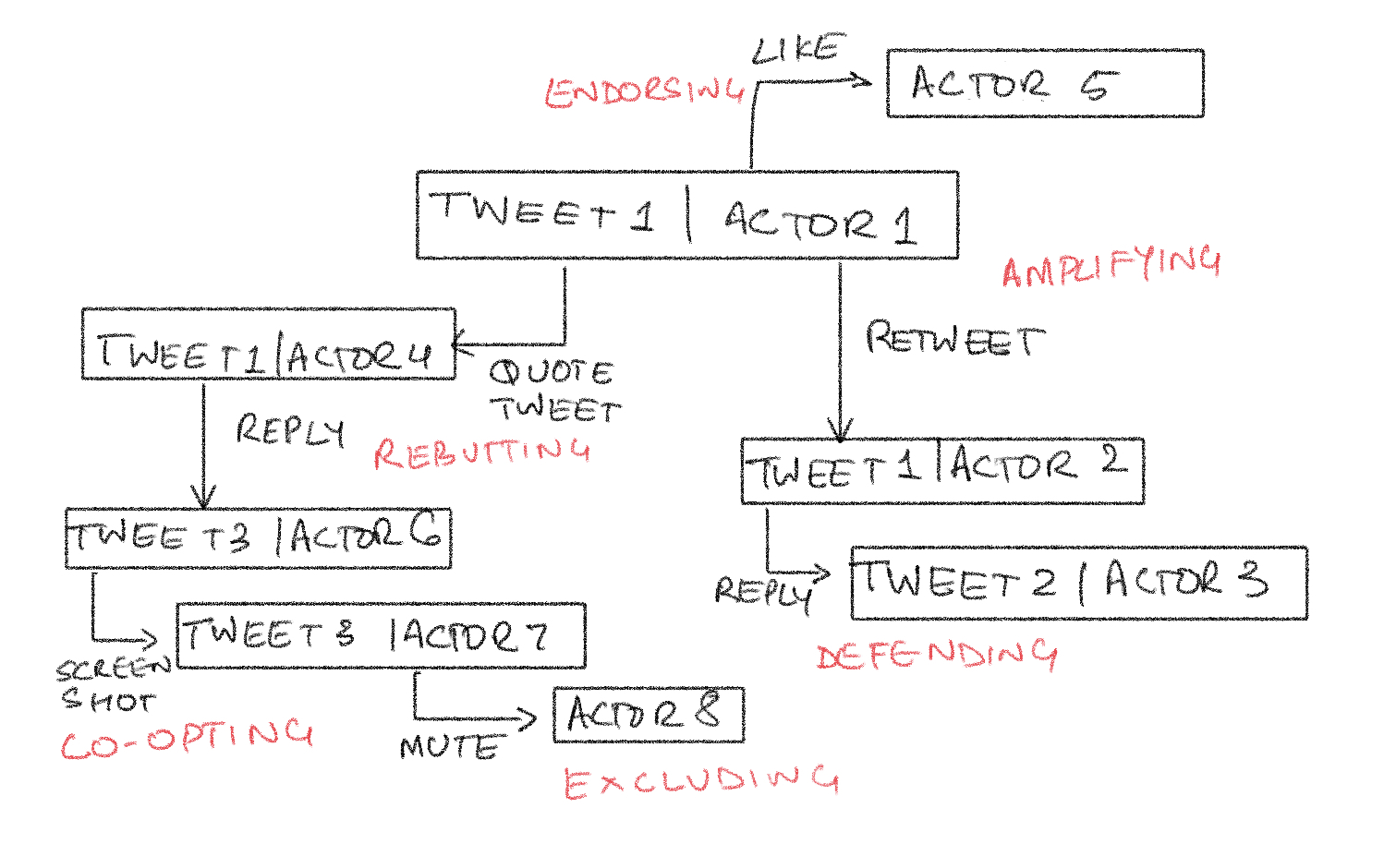
Using NLP to collaboratively surface patterns of meaning in large corpora

Image
I'm working on an empirical project with two co-authors, where a significant part of the central phenomenon we are studying unfolded online on twitter.  We have a massive multi year tweet and factiva news corpus that we sense-make together by periodically meeting to discuss the data and to theorize qualitatively from algorithmically generated representations of and algorithmically sampled texts from the corpus, previously drawn models of the phenomenon, memos, manuscripts, etc. We each of us have varying familiarity/expertise around the special phenomenon, the substrate upon which it unfolds (online discourse), the theoretical/research conversation in which are participating, and NLP. In collaboration, we see things.  I'm currently working on creating a visual representation of key themes (based on a BERTopic model) in the corpus, in particular the twitter discourse, over time and across our own interpreted actor categories. An interesting macro pattern emerged in convers...

Engaging with Online Discourse

Image
Over this summer, I've had the opportunity to experiment with the Twitter API's Academic Track product. I'm going to write about that today. I've been taking a break from this blog this summer to focus on my comprehensive exams (next month!) but I've been noodling around with some thoughts on online discourse and I feel its time to put something down in words. Plus its like a palette cleanser from the endless volumes of papers I have been reading, a chance to produce, instead of consuming.  First, some context: I love discourse. Words produced by people, intended often for other people to read. I like to look at it, understand the the motivations and intent behind words, to identify structures therein. And when I say structures, I mean the socially produced (often through repeated action) rules about what constitutes acceptable conduct given a particular social context, given the constraints and affordances of the technologies surrounding that social context. A  Gid...