Posts

Showing posts with the label research methods

What I mean by computationally entangled interpretive research

Image
Holy moly, I can barely believe it, I'm an actual assistant professor now.  Surrealness nothwithstanding, I have to engage with my new chosen academic field of IS/Information Systems. And so I've proposed a TREO talk at ICIS 2026  in Lisbon called " Computationally-Entangled Interpretive Methods: Using Computation In, and In Service Of, Interpretation. " ICIS is the flagship IS conference, and a TREO talk is short, five-ish minutes, an opinion piece more than a paper. That format forces compression, and compression tends to leave a position under-explained. This post is my attempt to say more plainly what I mean, mostly for myself. The starting problem is size. Organizational and social life increasingly leaves traces in corpora, digital trace data, social media archives, news archives, that are too large to read closely. A researcher used to sitting with transcripts or field notes now faces millions of documents. The compounding problem is the tendency in my fie...

Using NLP to collaboratively surface patterns of meaning in large corpora

Image
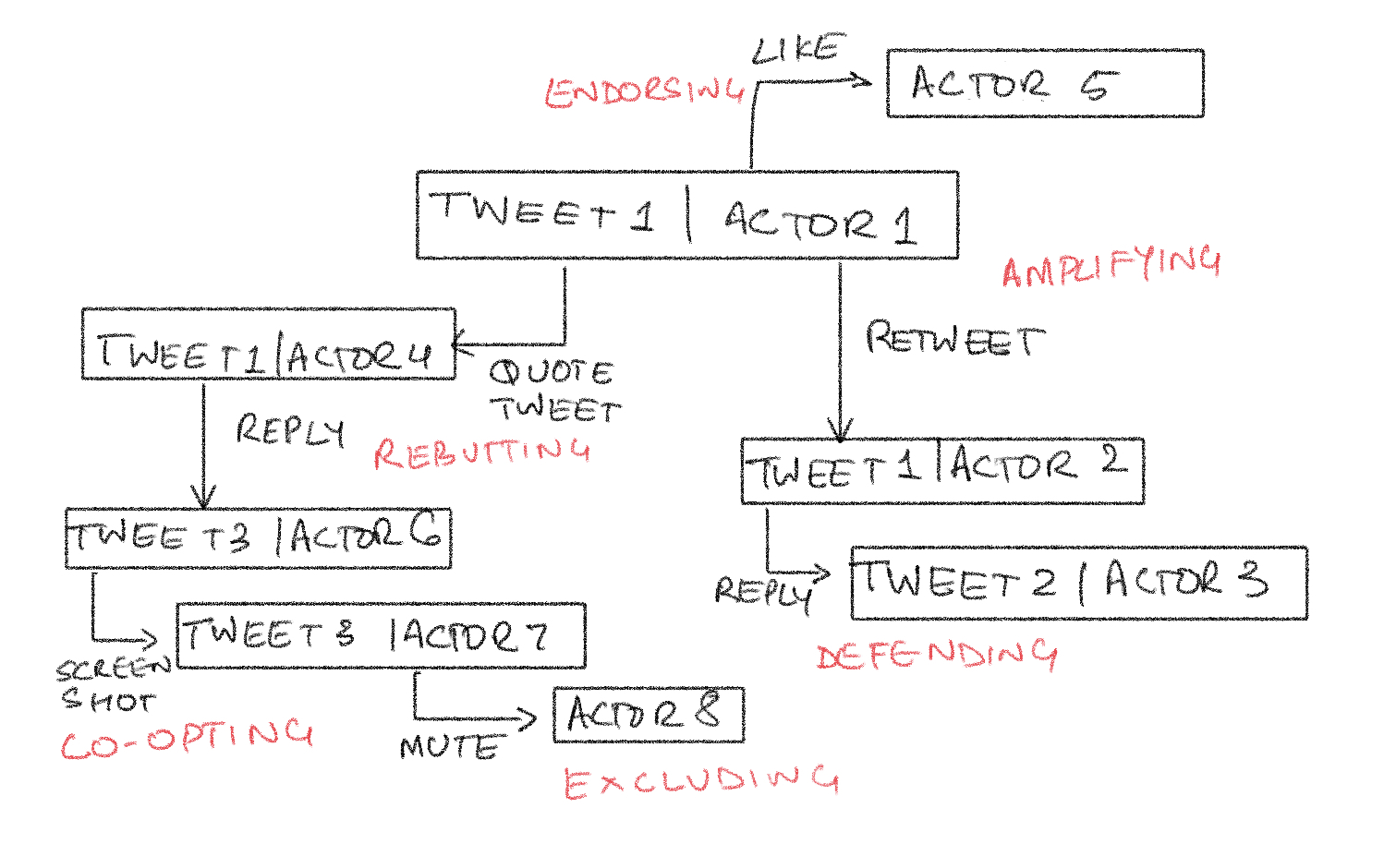
I'm working on an empirical project with two co-authors, where a significant part of the central phenomenon we are studying unfolded online on twitter.  We have a massive multi year tweet and factiva news corpus that we sense-make together by periodically meeting to discuss the data and to theorize qualitatively from algorithmically generated representations of and algorithmically sampled texts from the corpus, previously drawn models of the phenomenon, memos, manuscripts, etc. We each of us have varying familiarity/expertise around the special phenomenon, the substrate upon which it unfolds (online discourse), the theoretical/research conversation in which are participating, and NLP. In collaboration, we see things.  I'm currently working on creating a visual representation of key themes (based on a BERTopic model) in the corpus, in particular the twitter discourse, over time and across our own interpreted actor categories. An interesting macro pattern emerged in convers...

The data-ness of knowing from qualitative fieldwork

Image
I've been asked to offer some thoughts on fieldwork and data collection at a BricoLab meeting tomorrow, thought I could use this space to ruminate.  Not everything one comes across during fieldwork is "data". I think qualitative fieldwork is incredible because it produces profound knowledge about settings and phenomena. If one truly knows something they can write conceptual or theoretical pieces about it all day long. However knowing the phenomenon is not the same thing as having data about the phenomenon . And I am ultimately an empiricist and I need data.  I also want to recognize that its not as simple as data/not data. Its not a binary. I believe there is a continuum of data-ness of knowing from qualitative fieldwork, along the dimension of reflecting + encoding.  Let me try to explain what I mean by that... You come out of a session in the field, an observation session, and interview, whatever. You are buzzing with excitement about what you have discovered, yo...

Special issues as field-configuring events

 I've been noodling around with the idea of modeling knowledge processes at the level of the field for a few years now.  It didnt start this way; this is something I started a couple weeks before I started the PhD at McGill, as a way to start to make sense of the community I was joining- an exploration of the "A" management journals in the 21st century. As the core network data has grown to encompass all ( ALL you say? how dare you. ) of management research since its roots in the 1930s, it has become impossible to resist further examination.  Kuhn's notions of normal/revolutionary science never quite fit what I saw out "in the field" or in this data, and I was always looking for alternate analytic metaphors to describe our field of management or whatever you want to call the soup of social science and/or economics flavored sub-disciplines organized under the various B-schools of the world.  I dont want to bore everyone with the details (also maybe I want to...

Deductive, Inductive, Abductive: Inference strategies and argument construction in three management research traditions

Image
 Its been a while since I've written here. Its been a summer of ethnographic fieldwork and much of my "writing energy" has been consumed in memo-ing.  However, I happened to find an old essay I wrote for my comprehensive exams around about a year ago, and wonder of wonders - I don't hate it. So here it is. First, the question in response to which this essay was written:  What reasoning strategies exist for advancing from empirical generalizations to theoretical arguments? When researchers advance from empirical generalizations to theoretical arguments, they are in effect making two moves: making inferences or advancing from empirical generalizations to theoretical claims, and constructing theoretical arguments or rhetorically persuading an audience that said theoretical claims are valid (Ketokivi & Mantere, 2010; 2021). These moves are not strictly sequential- arguments are not necessarily constructed before or after the inferences have been made, although in some...

Engaging with Online Discourse

Image
Over this summer, I've had the opportunity to experiment with the Twitter API's Academic Track product. I'm going to write about that today. I've been taking a break from this blog this summer to focus on my comprehensive exams (next month!) but I've been noodling around with some thoughts on online discourse and I feel its time to put something down in words. Plus its like a palette cleanser from the endless volumes of papers I have been reading, a chance to produce, instead of consuming.  First, some context: I love discourse. Words produced by people, intended often for other people to read. I like to look at it, understand the the motivations and intent behind words, to identify structures therein. And when I say structures, I mean the socially produced (often through repeated action) rules about what constitutes acceptable conduct given a particular social context, given the constraints and affordances of the technologies surrounding that social context. A  Gid...

Coherence in Machine-Assisted Qualitative Research

Image
This is the first  in a  series of posts  exploring  the notion of coherence when using topic  modeling  methods like Latent Dirichlet Allocation (LDA) for qualitative analysis of texts. I'm trying to think about how mechanically measured coherence matters when you are trying to interpret something qualitatively from a large corpus of texts (with the assistance of machine-learning tools). Having estimated many, many LDA models of  similar  corpora of texts over the last few months for one reason or the other , I have started to observe some methodologically salient patterns in coherence . So  this post will amount to me trying to reflect on the tacit knowledge gained from "doing" topic modeling repeatedly. I hope there is value in this for others attempting to use methods like LDA to support qualitative analysis of texts. To illustrate my reflections, I will refer to a "vignette," comprised of R code, results, and visualizations of LDA ana...

Abhivadaye: Lineage in knowledge produced by communities of experts

Image
This is how I count things.  Its weird, I know. I count in base 12. I never gave it much thought before. I was wondering about it this past weekend so I asked my Dad about it during our weekend call. He said it was how Tamil Brahmins are taught to count off their chants. I must have retained it from when I was taught the Sandhyavandanam as a kid. There is a vedic tradition in some communities in south India- that of the elaborate self-introduction. This is called the  abhivadaye  (uh-bhee-VAA-da-yay). In it, in addition to your name, parent's name, and class signifiers, you also declare your scholarly clan, and chosen significant texts. I was taught how to introduce myself like this. In the abhivadaye I see the evidence of interactions between social and semantic structures, and how they produce each other. If there's a single antecedent to my interests in this line of inquiry, it is my meditations on the practice of abhivadaye.    Better scholars than me have...

Rediscovering writing

Its no coincidence that I started this blog around the same time as I started fieldwork this fall.  There's a profound meditative quality to developing a thought through iterations of text. I'm referring to memo writing, an important aspect of qualitative research methods. I am quite good at maintaining discipline among my numbers. All my quantitative data, be it from a research project or personal logs, are well organized. My folder structure is orderly, my paths consistent, my code annotated and clean. Read JP Ferguson's post on this for inspiration if you want to do this as well. However, the idea of discipline among my words is new to me. Which is why I so glad Samer insists on disciplined memoing to accompany fieldwork. For each observation session, I take field notes, always by hand (delike alpha with a fude nib with iroshizuku shin ryoku ink on 80gsm paper notebooks). I then type out my field notes into a word doc in a secure cloud drive to which Samer has access. T...

Time and lineage in text analysis

Image
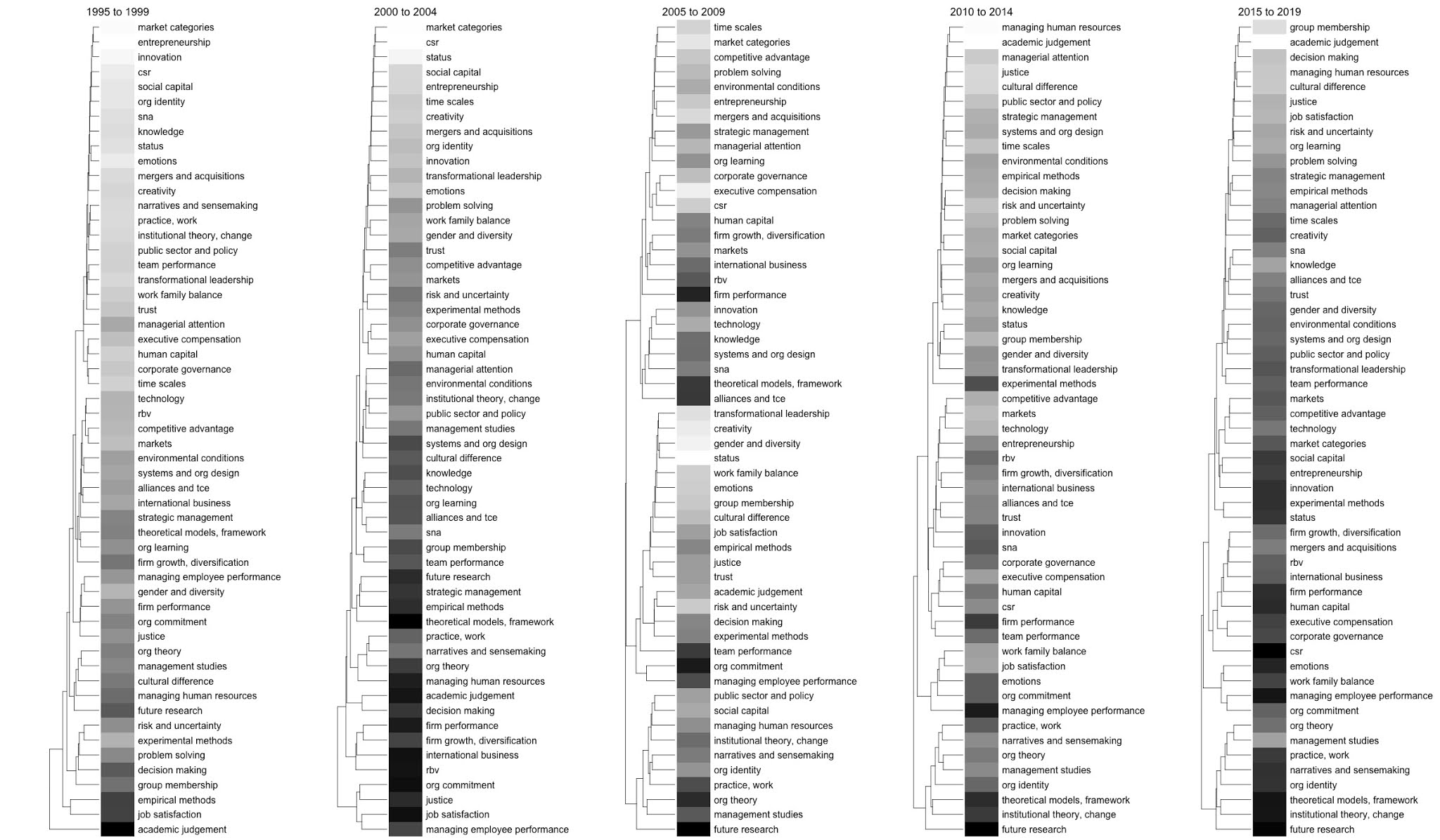
I've been working on a few parallel projects that involve topic modeling abstracts of managment research publications (See Topics in Management Research , for example). My method of choice at the moment is Latent Dirichlet Allocation .  I'm finding that this class of methods is useful in ways I hadn't quite expected when I started this exercise about a year ago in order to be able to test some hypotheses about management research in a causal inference/regression context. Since then I have been exploring the use of topic modeling for qualitative analysis. This sort of use of topic modeling is well represented in modern management research (See Hannigan et al., 2019 , a tremendous, encyclopedic review of the subject).  Sidebar: I'm still grappling with the distinction between quantitative and qualitative research. The terminology is deployed, at least in the circles I'm in, in a way that implies an eqivalence between qualitative and inductive research, and quantitativ...