Posts

Showing posts with the label sociosystematics

Special issues as field-configuring events

 I've been noodling around with the idea of modeling knowledge processes at the level of the field for a few years now.  It didnt start this way; this is something I started a couple weeks before I started the PhD at McGill, as a way to start to make sense of the community I was joining- an exploration of the "A" management journals in the 21st century. As the core network data has grown to encompass all ( ALL you say? how dare you. ) of management research since its roots in the 1930s, it has become impossible to resist further examination.  Kuhn's notions of normal/revolutionary science never quite fit what I saw out "in the field" or in this data, and I was always looking for alternate analytic metaphors to describe our field of management or whatever you want to call the soup of social science and/or economics flavored sub-disciplines organized under the various B-schools of the world.  I dont want to bore everyone with the details (also maybe I want to...

On Academic Labels and the Genesis of Norms

Image
I recently had to write a short bio of myself (an autobio?) because Samer convinced me to throw my name in for student rep for the Academy of Management (AoM)  Communication, Digital Technology, and Organizations (CTO) division. In writing that bio,  I got thinking about the labels that academics give themselves to establish their domain of expertise, and to signal the community to which they belong (which in turn signifies in some ways how they see the world and engage in studying it.  I study how organizations use technology, think about technology, talk about it. I used to work in the Communications, Media, and Technology (CMT) division of Accenture within the Applied Analytics practice. So I think I'm a good fit. But I have no real experience with the AoM's CTO. I also happen to have the odd distinction of having a previous PhD. In the original draft of my bio, I had mentioned my prior PhD in Ecology. Samer, knowing in some detail about the content of my prior PhD, ...

Tadviddhi pranipaaténa: Lived experience and expertise and the inheritance of knowledge

The weight of the wisdom that had just been bestowed on them weighed heavily on their shoulders. The sacrifices made by the small group of students to be able to gather at this school radiated as uncomfortable heat from these burdens.  For nearly an hour the master has spoken about the movement-forms, their powers, the confluences of energies, the dangers. A small, gray figure, seated, in flowing robes.  The master returned from reverie, noticing the askance glances of the gathered groups.  "Hmm, now I will show you."  A flash of robes, and the master was standing at a short distance, subtly hiking up the flowing the robes so that the details of the footwork may be visible. First, the right foot rises slightly, and is then firmly planted into the ground, a movement both silent and thunderous. From here, the movement-forms begin. A flurry of movements. The master swiftly transitions from form to form, pausing for just a second on each, power and precision radiating fr...

Coherence in Machine-Assisted Qualitative Research

Image
This is the first  in a  series of posts  exploring  the notion of coherence when using topic  modeling  methods like Latent Dirichlet Allocation (LDA) for qualitative analysis of texts. I'm trying to think about how mechanically measured coherence matters when you are trying to interpret something qualitatively from a large corpus of texts (with the assistance of machine-learning tools). Having estimated many, many LDA models of  similar  corpora of texts over the last few months for one reason or the other , I have started to observe some methodologically salient patterns in coherence . So  this post will amount to me trying to reflect on the tacit knowledge gained from "doing" topic modeling repeatedly. I hope there is value in this for others attempting to use methods like LDA to support qualitative analysis of texts. To illustrate my reflections, I will refer to a "vignette," comprised of R code, results, and visualizations of LDA ana...

Abhivadaye: Lineage in knowledge produced by communities of experts

Image
This is how I count things.  Its weird, I know. I count in base 12. I never gave it much thought before. I was wondering about it this past weekend so I asked my Dad about it during our weekend call. He said it was how Tamil Brahmins are taught to count off their chants. I must have retained it from when I was taught the Sandhyavandanam as a kid. There is a vedic tradition in some communities in south India- that of the elaborate self-introduction. This is called the  abhivadaye  (uh-bhee-VAA-da-yay). In it, in addition to your name, parent's name, and class signifiers, you also declare your scholarly clan, and chosen significant texts. I was taught how to introduce myself like this. In the abhivadaye I see the evidence of interactions between social and semantic structures, and how they produce each other. If there's a single antecedent to my interests in this line of inquiry, it is my meditations on the practice of abhivadaye.    Better scholars than me have...

Time and lineage in text analysis

Image
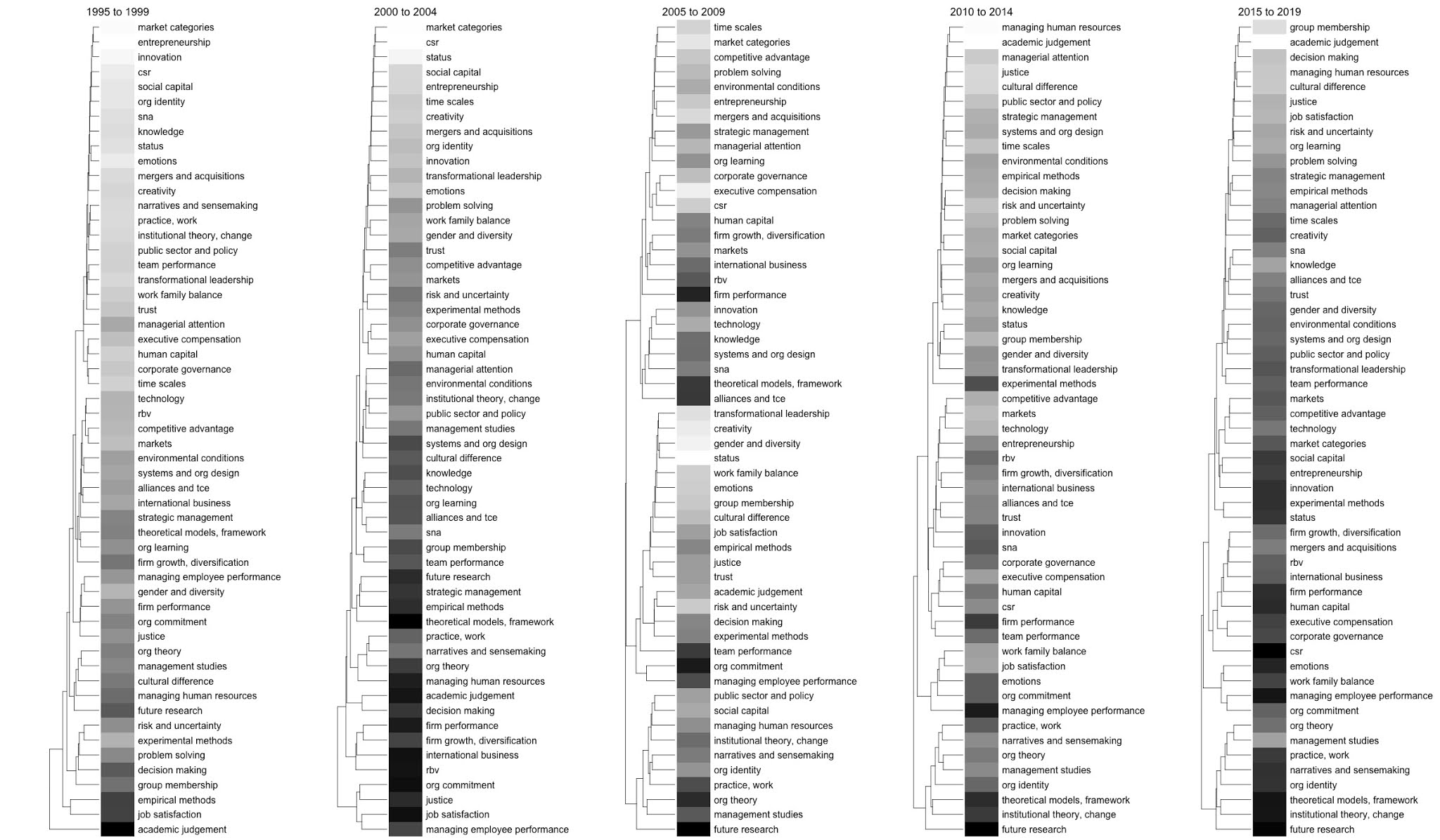
I've been working on a few parallel projects that involve topic modeling abstracts of managment research publications (See Topics in Management Research , for example). My method of choice at the moment is Latent Dirichlet Allocation .  I'm finding that this class of methods is useful in ways I hadn't quite expected when I started this exercise about a year ago in order to be able to test some hypotheses about management research in a causal inference/regression context. Since then I have been exploring the use of topic modeling for qualitative analysis. This sort of use of topic modeling is well represented in modern management research (See Hannigan et al., 2019 , a tremendous, encyclopedic review of the subject).  Sidebar: I'm still grappling with the distinction between quantitative and qualitative research. The terminology is deployed, at least in the circles I'm in, in a way that implies an eqivalence between qualitative and inductive research, and quantitativ...