Posts

Showing posts with the label algorithms

Reading the fog: Using semantic search to interpret social media noise about "black october"

Image
  “Black October” is the name some people are using for what is reportedly a series of AI-driven cybersecurity incidents, still unfolding as I write this. It is an emerging phenomenon in the most literal sense. The events are still happening, the name hasn’t settled, and nobody quite agrees on what counts as part of it. Or if it is happenning at all. For something this new, social media is in a perpetual state of fog of war. Posts arrive before the vocabulary does. And if you try to find them by keyword, you hit an obvious problem: “black”, “October” and “AI” are some of the most ordinary words on the internet in autumn. Search for them together and you get Halloween art, festivals, and a lot of general hand-wringing about AI, with the posts you actually want scattered somewhere inside. Using this as a way to think through what searching semantically rather than just searching lexically might look like in practice. First, go wide to get a broad corpus I searched the AT Protocol net...

What I mean by computationally entangled interpretive research

Image
Holy moly, I can barely believe it, I'm an actual assistant professor now.  Surrealness nothwithstanding, I have to engage with my new chosen academic field of IS/Information Systems. And so I've proposed a TREO talk at ICIS 2026  in Lisbon called " Computationally-Entangled Interpretive Methods: Using Computation In, and In Service Of, Interpretation. " ICIS is the flagship IS conference, and a TREO talk is short, five-ish minutes, an opinion piece more than a paper. That format forces compression, and compression tends to leave a position under-explained. This post is my attempt to say more plainly what I mean, mostly for myself. The starting problem is size. Organizational and social life increasingly leaves traces in corpora, digital trace data, social media archives, news archives, that are too large to read closely. A researcher used to sitting with transcripts or field notes now faces millions of documents. The compounding problem is the tendency in my fie...

Using NLP to collaboratively surface patterns of meaning in large corpora

Image
I'm working on an empirical project with two co-authors, where a significant part of the central phenomenon we are studying unfolded online on twitter.  We have a massive multi year tweet and factiva news corpus that we sense-make together by periodically meeting to discuss the data and to theorize qualitatively from algorithmically generated representations of and algorithmically sampled texts from the corpus, previously drawn models of the phenomenon, memos, manuscripts, etc. We each of us have varying familiarity/expertise around the special phenomenon, the substrate upon which it unfolds (online discourse), the theoretical/research conversation in which are participating, and NLP. In collaboration, we see things.  I'm currently working on creating a visual representation of key themes (based on a BERTopic model) in the corpus, in particular the twitter discourse, over time and across our own interpreted actor categories. An interesting macro pattern emerged in convers...

Beyond the blob: a conceptual genAI architecture

Image
What is AI? I've written about this before , and given that it is an emerging technology, I understand that there are many conceptions of AI. In this post I'm referring specifically to generative AI. However, after having reviewed the Nth management/IS manuscript that treats genAI as some amorphous blob that does everything and nothing, and learns from everything and nothing, I decided I should try and break it down into components. My emphasis here is function and modularity of the various components that come together to perform "genAI". Will keep iterating on this for a class Samer is teaching.

On epistemic authority and how humans commit LLMs to courses of action

Image
Samer recently posted about our just-accepted Strategic Organization paper on LinkedIn. The usual likes, congrats, and promises to read followed. Some comments engaged with the content of the paper (he linked to the pre-print, as I have here) and discussion ensued. Got me thinking, here we have professionals who collaborate with each other, engaging in public discourse about problems in the world while using shared and similarly embedded core vocabularies (same words same meanings). Sounds very much like my operationalization of a research conversation . Interesting. Feels different, somehow, from old academic twitter. Maybe because we imbue LinkedIn with some institutional meanng, its where jobs are posted, its more "serious" than twitter was, its more like a conference than a public square.  Less hoi polloi more formal strutting. Interesting. More to the point of the subject line of this post, I’m referring to Joel Baum’s comment on Samer's post and the subsequent rep...

What happens to Reflexivity? Centering the traditional qualitative research process in a world of AI tools

Image
Watching the curve bend toward AI. I am seeing qualitative work drift toward computation across my field of managment research. Certainly a lot of it at the academy in Copenhagen this year. This is not a surprise. As organizational digital traces become increasingly abundant and in some ways essential to inquiry what kinds of questions become thinkable that were previously out of reach, and what kinds of questions become harder to keep going? Is there even a future where we can get away with not using AI? In this blog post I want to noodle on some thoughts on using AI while keeping the traditional qualitative research process at the center. If one thinks of  research with AI as a spectrum that starts on the one hand from “computationally entangled research” meaning a more-or-less traditional scholar using off-the-shelf tools to enagage with a corpus, to the more invovled prompt-based structuring of qual reserach (see Matt Grimes or Henri Schildt 's efforts), all the way to “inter...

Smart Scheduling and AI scheduling assistants: An extension of digital assistants

Smart Scheduling needs to be a thing. And by that I mean - AI-based (or: machine-learning-based) semi-automated scheduling assistants. It requires some giving in to the notion of letting an algorithm control a dimension of your life. But what you out of it is relief from the stress of scheduling. It would work best in a context where the transactions of scheduling (the negotiation of time, the creation of some textual artifact of agreement, etc.) are conducted between algorithms at both ends. That said, the alternative where the transactions are conducted between human and algorithm can be supported by an interactive virtual agent (IVA) beefed up with some conversational, possibly verbal, capabilitiies. Hello, this is Anand Bhardwaj's digital assistant speaking. Is this is a good time to talk? And the scheduling assistant can be plugged into other aspects of your lives. I have a pretty neatly organized calendar, organized into work (school, in my case), family, my wife's work c...

Time and lineage in text analysis

Image
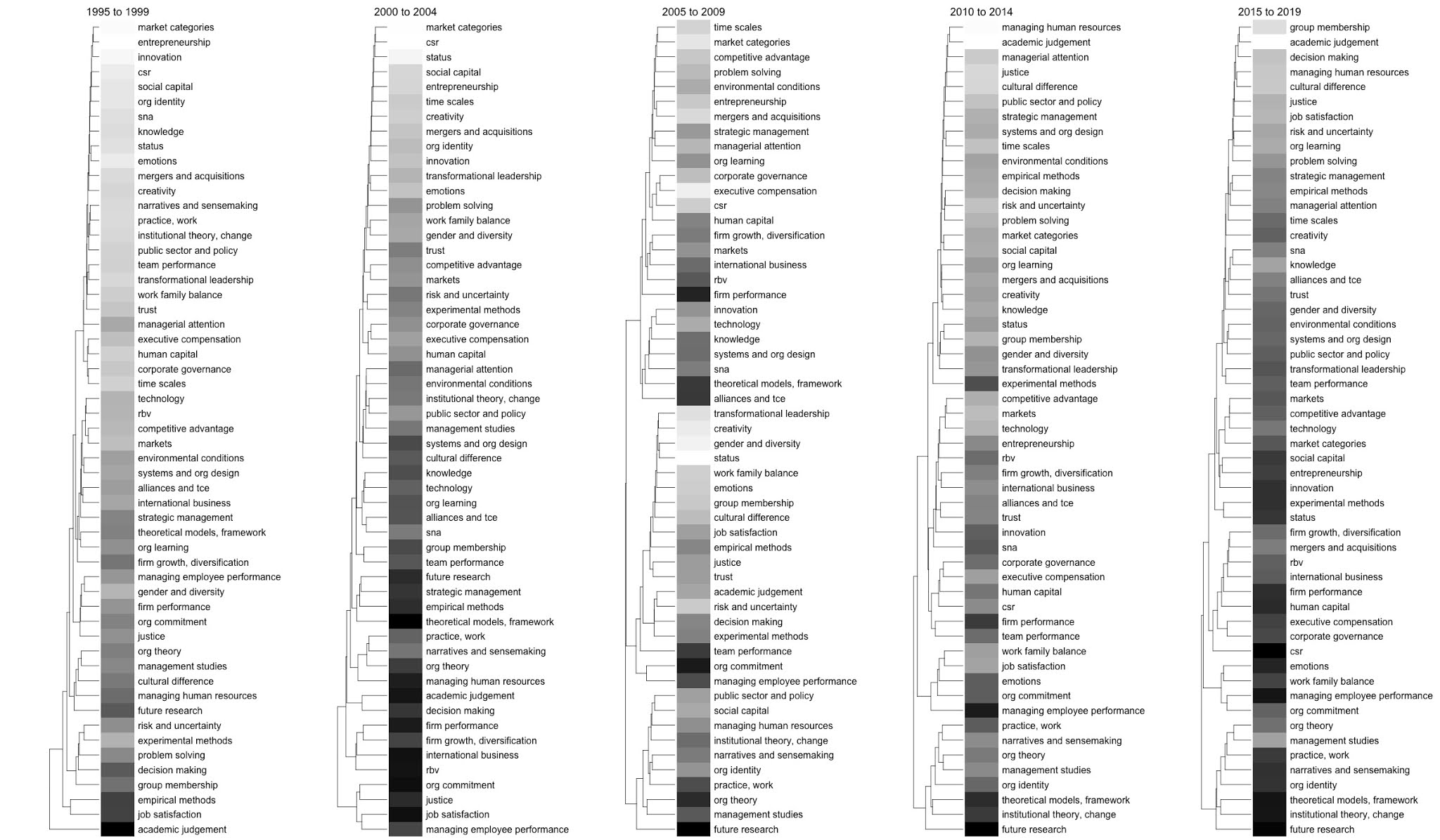
I've been working on a few parallel projects that involve topic modeling abstracts of managment research publications (See Topics in Management Research , for example). My method of choice at the moment is Latent Dirichlet Allocation .  I'm finding that this class of methods is useful in ways I hadn't quite expected when I started this exercise about a year ago in order to be able to test some hypotheses about management research in a causal inference/regression context. Since then I have been exploring the use of topic modeling for qualitative analysis. This sort of use of topic modeling is well represented in modern management research (See Hannigan et al., 2019 , a tremendous, encyclopedic review of the subject).  Sidebar: I'm still grappling with the distinction between quantitative and qualitative research. The terminology is deployed, at least in the circles I'm in, in a way that implies an eqivalence between qualitative and inductive research, and quantitativ...