Posts

Showing posts with the label process

Reading the fog: Using semantic search to interpret social media noise about "black october"

Image
  “Black October” is the name some people are using for what is reportedly a series of AI-driven cybersecurity incidents, still unfolding as I write this. It is an emerging phenomenon in the most literal sense. The events are still happening, the name hasn’t settled, and nobody quite agrees on what counts as part of it. Or if it is happenning at all. For something this new, social media is in a perpetual state of fog of war. Posts arrive before the vocabulary does. And if you try to find them by keyword, you hit an obvious problem: “black”, “October” and “AI” are some of the most ordinary words on the internet in autumn. Search for them together and you get Halloween art, festivals, and a lot of general hand-wringing about AI, with the posts you actually want scattered somewhere inside. Using this as a way to think through what searching semantically rather than just searching lexically might look like in practice. First, go wide to get a broad corpus I searched the AT Protocol net...

What I mean by computationally entangled interpretive research

Image
Holy moly, I can barely believe it, I'm an actual assistant professor now.  Surrealness nothwithstanding, I have to engage with my new chosen academic field of IS/Information Systems. And so I've proposed a TREO talk at ICIS 2026  in Lisbon called " Computationally-Entangled Interpretive Methods: Using Computation In, and In Service Of, Interpretation. " ICIS is the flagship IS conference, and a TREO talk is short, five-ish minutes, an opinion piece more than a paper. That format forces compression, and compression tends to leave a position under-explained. This post is my attempt to say more plainly what I mean, mostly for myself. The starting problem is size. Organizational and social life increasingly leaves traces in corpora, digital trace data, social media archives, news archives, that are too large to read closely. A researcher used to sitting with transcripts or field notes now faces millions of documents. The compounding problem is the tendency in my fie...

The office of a tenure track assistant professor

Sitting on my bed typing this, my apartment is in disarray. The movers come tomorrow, and everything we are taking with us to Denmark (aside from our suitcases) is packed into 22 small cartons, 9 plastic tubs, and 1 garment case. Books, stationery, clothes, a few toys, some mementos, coffee equipment, cast irons and Indian stainless steel and brass kitchenware. This is 20 years (13 for Aditi) of stuff we have accumulated in North America that we will take when we go. Reflecting on what w leave behind, I notice furniture, beds, linens, clothes, toys, almost everything in the kitchen, so many electronic devices and appliances and gadgets, so very many plants and ceramics. I remember that I left my car behind in Atlanta, 7 years ago. Headed to Copenhagen next Friday with Lara. Aditi will follow in a few weeks after getting in some more fieldwork. We have an apartment there already, and Lara and I will feather the nest in anticipation. I'd like to explore the city with her, maybe take ...

Using NLP to collaboratively surface patterns of meaning in large corpora

Image
I'm working on an empirical project with two co-authors, where a significant part of the central phenomenon we are studying unfolded online on twitter.  We have a massive multi year tweet and factiva news corpus that we sense-make together by periodically meeting to discuss the data and to theorize qualitatively from algorithmically generated representations of and algorithmically sampled texts from the corpus, previously drawn models of the phenomenon, memos, manuscripts, etc. We each of us have varying familiarity/expertise around the special phenomenon, the substrate upon which it unfolds (online discourse), the theoretical/research conversation in which are participating, and NLP. In collaboration, we see things.  I'm currently working on creating a visual representation of key themes (based on a BERTopic model) in the corpus, in particular the twitter discourse, over time and across our own interpreted actor categories. An interesting macro pattern emerged in convers...

The data-ness of knowing from qualitative fieldwork

Image
I've been asked to offer some thoughts on fieldwork and data collection at a BricoLab meeting tomorrow, thought I could use this space to ruminate.  Not everything one comes across during fieldwork is "data". I think qualitative fieldwork is incredible because it produces profound knowledge about settings and phenomena. If one truly knows something they can write conceptual or theoretical pieces about it all day long. However knowing the phenomenon is not the same thing as having data about the phenomenon . And I am ultimately an empiricist and I need data.  I also want to recognize that its not as simple as data/not data. Its not a binary. I believe there is a continuum of data-ness of knowing from qualitative fieldwork, along the dimension of reflecting + encoding.  Let me try to explain what I mean by that... You come out of a session in the field, an observation session, and interview, whatever. You are buzzing with excitement about what you have discovered, yo...

Special issues as field-configuring events

 I've been noodling around with the idea of modeling knowledge processes at the level of the field for a few years now.  It didnt start this way; this is something I started a couple weeks before I started the PhD at McGill, as a way to start to make sense of the community I was joining- an exploration of the "A" management journals in the 21st century. As the core network data has grown to encompass all ( ALL you say? how dare you. ) of management research since its roots in the 1930s, it has become impossible to resist further examination.  Kuhn's notions of normal/revolutionary science never quite fit what I saw out "in the field" or in this data, and I was always looking for alternate analytic metaphors to describe our field of management or whatever you want to call the soup of social science and/or economics flavored sub-disciplines organized under the various B-schools of the world.  I dont want to bore everyone with the details (also maybe I want to...

Deductive, Inductive, Abductive: Inference strategies and argument construction in three management research traditions

Image
 Its been a while since I've written here. Its been a summer of ethnographic fieldwork and much of my "writing energy" has been consumed in memo-ing.  However, I happened to find an old essay I wrote for my comprehensive exams around about a year ago, and wonder of wonders - I don't hate it. So here it is. First, the question in response to which this essay was written:  What reasoning strategies exist for advancing from empirical generalizations to theoretical arguments? When researchers advance from empirical generalizations to theoretical arguments, they are in effect making two moves: making inferences or advancing from empirical generalizations to theoretical claims, and constructing theoretical arguments or rhetorically persuading an audience that said theoretical claims are valid (Ketokivi & Mantere, 2010; 2021). These moves are not strictly sequential- arguments are not necessarily constructed before or after the inferences have been made, although in some...

On concocting a coffee service

Image
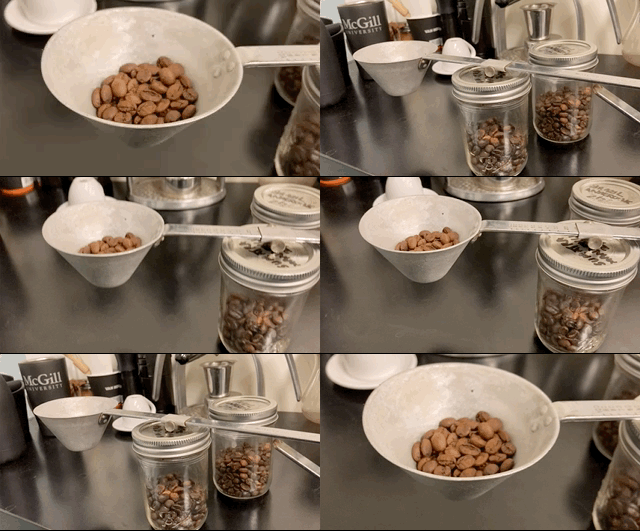
 I find it hard to write or talk about coffee online. For good coffee discourse, I can think of no better venue than James Hoffman's YouTube channel . My blog right here is more if you like incoherent rambling. The problem for me is that coffee is ultimately a matter of taste. Without the taste, the actual experience of a good coffee, text about coffee is, well, bland. And so I love to talk about coffee, over a coffee. During work hours, I will prepare a coffee for pretty much anyone who wants one (+ one for me), if they come by my office (545 Bronfman, McGill U). I prefer a ristretto but I do also offer regular espresso, pourover and moka. It's mostly my fellow grad students, though occasionally I get local and visiting faculty too. We don't have to talk about coffee (though I won't say no to that).  The joy of the coffee service, to me, is the pleasure of discovery. Every service is unique. I usually have 3-4 types of beans on offer at any given time, and I blend them...

My Coffee Ritual

Image
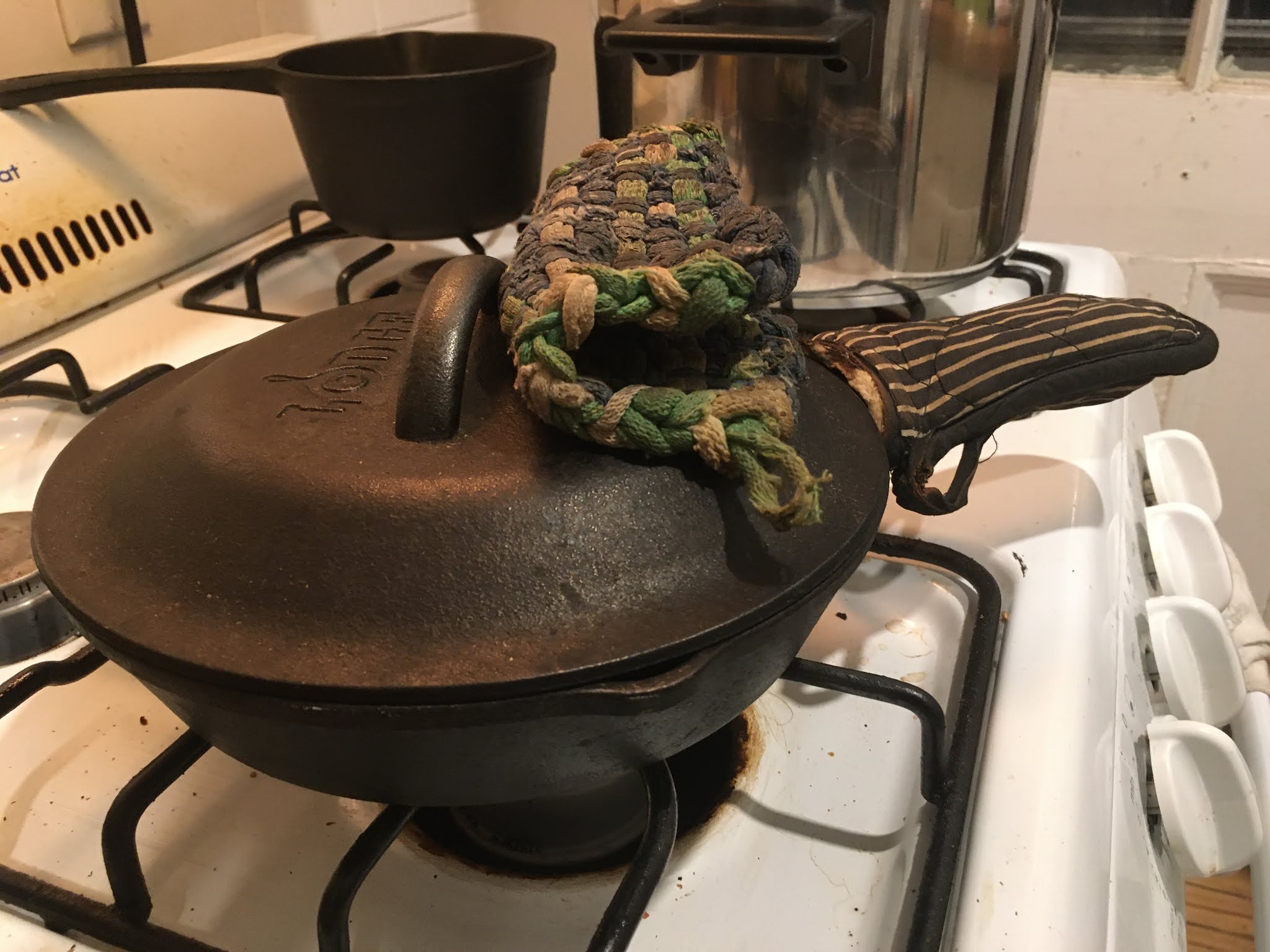
Coffee is an important part of my life, and my daily coffee ritual changes every few months. My current method for preparing coffee is espresso. The Bean This week, I'm doing a 50/50 blend. I'm working with a Tanzanian peaberry and my usual base bean, the South Indian Malabar " monsooned " or age cured bean. Both are arabica. I bought both beans, unroasted, from Green Beanery . I have hand roasted both beans, each separately in my coffee cast irons to around  City+  this past weekend, so its now 3 days post roast. With African beans, perhaps because of the coffee processing practices in the region, I find that small bits of skin remain on the bean during the roast, which then fall off when I roll the beans in the skillet. With Indian beans, I have found that the whole skin slides off from the bean as a single "husk". This peaberry is quite dense and takes longer to roast than the lighter yet bigger monsooned bean, however the former rolls quite well in the s...

Process is Protagonist in Greyhound

Image
It was in the closing seconds of the 2020 movie Greyhound , as we pan out to a shot of the wide ocean and the battle-weary remnants of a convoy of Allied destroyers, that I wondered for the first time in roughly an hour and a half, "was this shot on a boat or a set?" And that's because Greyhound is one of those movies that makes you forget you're watching a movie for a while. With its meticulous realism, and a whole bunch of close-ups of an underplayed and very effective performance by Tom Hanks, this movie reminds me of some of the more intense war scenes from Band of Brothers and Saving Private Ryan . Except, the whole movie is the intense war scene.  Paradoxically given it's expansive ocean setting, this movie unfolds in a very small space- with a few small exceptions, the human perfomances in this movie take place in the chart house, the plotting room and the pilot house (and the decks to its port and starboard) of a Fletcher-class WW2 destroyer. Three opera...

Time and lineage in text analysis

Image
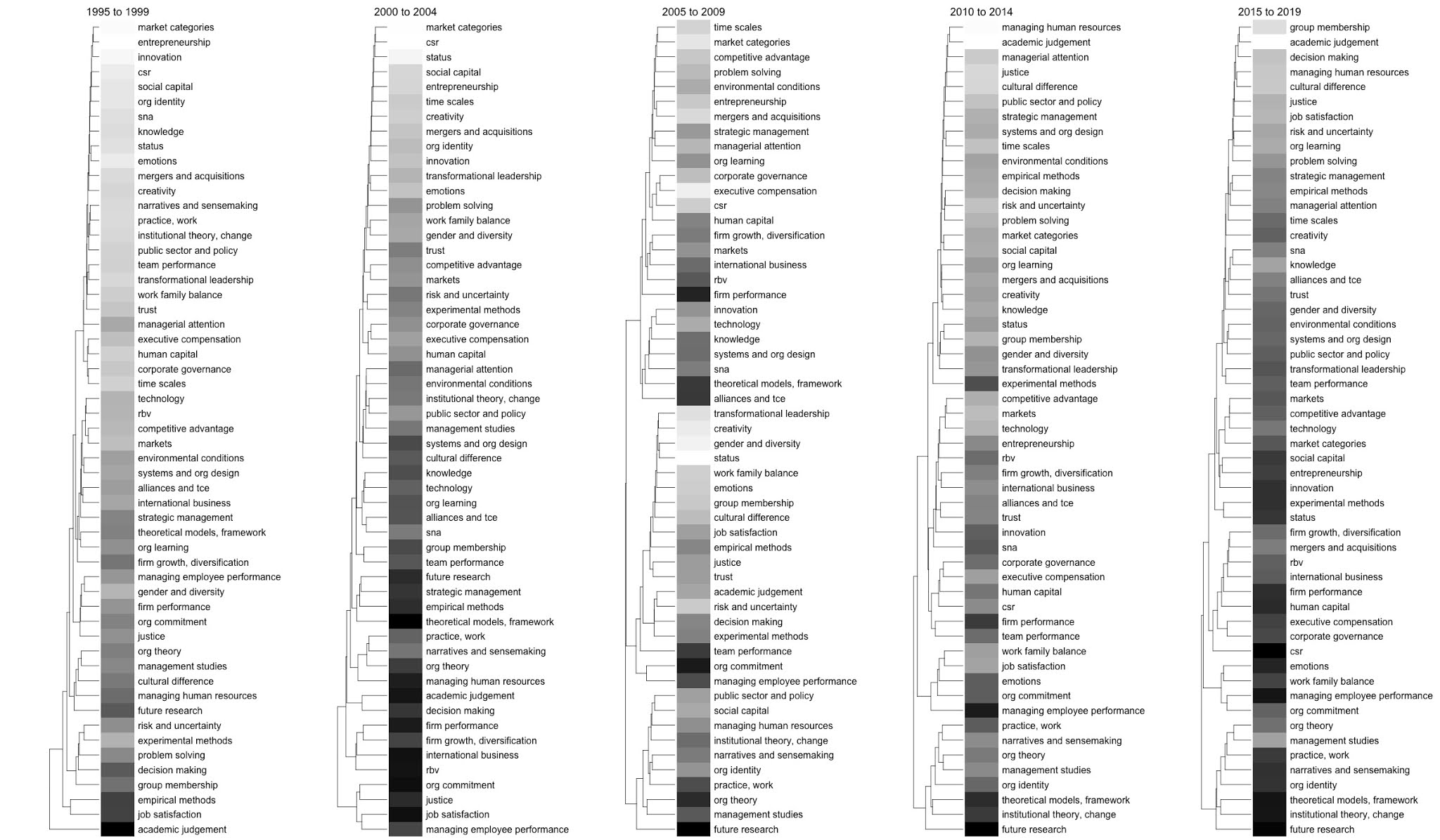
I've been working on a few parallel projects that involve topic modeling abstracts of managment research publications (See Topics in Management Research , for example). My method of choice at the moment is Latent Dirichlet Allocation .  I'm finding that this class of methods is useful in ways I hadn't quite expected when I started this exercise about a year ago in order to be able to test some hypotheses about management research in a causal inference/regression context. Since then I have been exploring the use of topic modeling for qualitative analysis. This sort of use of topic modeling is well represented in modern management research (See Hannigan et al., 2019 , a tremendous, encyclopedic review of the subject).  Sidebar: I'm still grappling with the distinction between quantitative and qualitative research. The terminology is deployed, at least in the circles I'm in, in a way that implies an eqivalence between qualitative and inductive research, and quantitativ...